Description
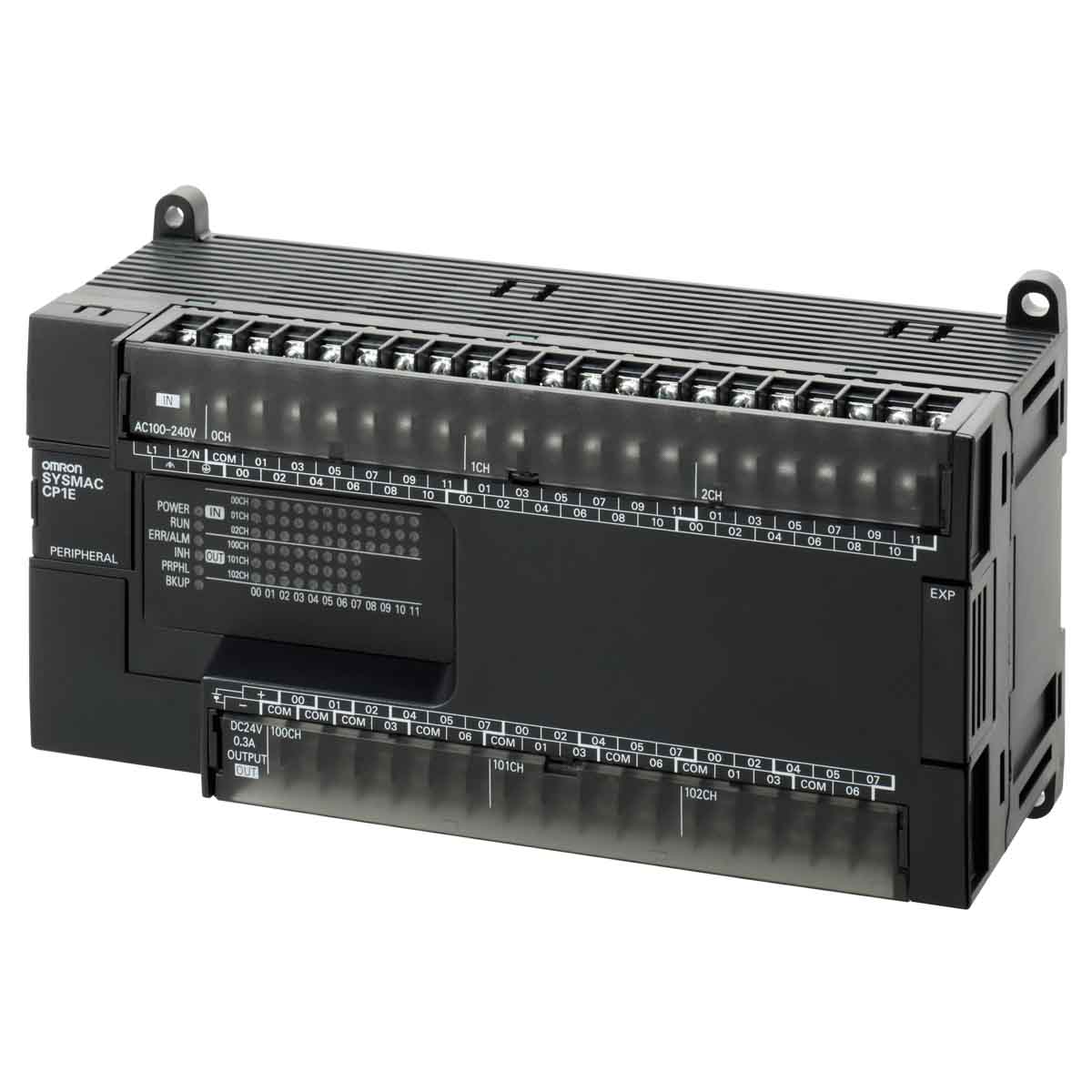
Here’s a Q&A style summary of the CP1E‑E60SDR A (Omron CP1E series) — its strengths, trade‑offs, and things to watch out for.
Basic Specifications (Overview)
- Supply voltage: 100 to 240 VAC (Adegis)
- Built‑in I/O: 60 points total (36 inputs, 24 relay outputs) (IndMALL Automation)
- Program capacity: ~ 2,000 steps (2K) (Omron)
- Data memory: ~ 2,000 words (Adegis)
- Max I/O expandability: can add expansion units (max I/O for E/N/NA/SDR type is up to 180 with expansions) (Omron)
- Other features: supports USB, RS‑232C, and RS‑485 (through option boards) (Omron)
- Operating temperature: 0 to 55 °C, humidity 10% – 90% (IndMALL Automation)
Pros (Strengths)
- Good I/O density
With 36 inputs + 24 outputs built in, this module gives a solid number of I/O without needing expansion immediately. This is advantageous for mid‑sized control tasks. - Flexibility and expandability
You can add expansion units (I/O, analog, temperature, communications) to scale the system as needed. (Omron) - Multiple communication options
Through option boards, you can interface via USB, RS‑232, RS‑485, Ethernet, etc. This helps integrate with various systems. (Omron) - Compact size & standard mounting
Reasonably compact for its class (dimensions ~ 195 × 90 × 79 mm) (Adegis) and mountable in standard panels. Good for saving cabinet space. - Reliable for many industrial environments
It meets typical environmental ratings, has decent shock/vibration resistance (per spec sheets), and is made by a reputable automation manufacturer. - Cost-effective “middle ground” PLC
It sits between very small, low-I/O PLCs and high-end models. For many applications, it provides a good balance of features vs cost.
Cons (Limitations & Trade-offs)
- Limited program memory / size
The ~2K step limit constrains how large or complex your ladder logic can be. For systems with many functions, math, or data handling, you may hit this ceiling. - Relay outputs only in built-in outputs
The built-in outputs are relay type, which are slower and have mechanical wear compared to transistor outputs. For high-speed switching or very frequent cycling, relay outputs may be a limitation. - Speed limitations for very high-speed tasks
Although it supports high-speed counters and input interrupts, for very fast control loops or tight timing requirements you may hit performance limits compared to higher-end PLCs. (Omron) - Expansion is capped
While expansion is possible, there’s a ceiling on how many expansion units and total I/O you can add. According to specs, for E-series, the max is 180 I/O when using 3 expansion units. (Omron) - No built-in analog I/O
This CPU (E60SDR) does not include analog inputs/outputs natively (unlike NA types). If your system needs analog sensing or control, you’ll need to add external analog modules. (Omron) - Potential future limitations / obsolescence
As systems grow or requirements increase, this model may become inadequate and require migrating to a higher-series PLC. Also, support or replacement parts in the future might become less convenient. - Relay output wear & slower switching
Because many operations rely on mechanical contacts, the lifespan is less than solid-state outputs. Frequent switching especially near limits can wear them.
Q&A (Common Questions)
| Question | Answer |
| Can I control analog signals (e.g. 4–20 mA, temperature) with CP1E‑E60SDR A? | Not directly in the base CPU; you’ll need to add analog I/O modules or special boards for analog and temperature inputs. |
| What is the maximum total I/O I can reach with expansions? | Up to 180 I/O points for E/N/NA/SDR series when adding up to 3 expansion units. (Omron) |
| Does it support high-speed counting / interrupts? | Yes, it has built-in high-speed counter support and input interrupts within its spec limits. (Omron) |
| Is the programming environment standard or custom? | It uses the standard Omron CX‑Programmer (ladder logic). |
| Can I connect to this PLC via USB / serial / Ethernet? | Yes, via option boards (USB, RS‑232C, RS‑485, Ethernet) you can establish communications. (Omron) |
| What happens if program size grows too big? | You may run out of steps/memory and be forced to refactor logic, segment the program, or migrate to a higher PLC series. |
| Is this a good choice for long-term expansion? | It’s decent for mid-term growth, but for systems expected to scale very large or require more advanced features, a higher-tier PLC may be more future-proof. |
If you like, I can compare CP1E‑E60SDR A with some alternative PLCs (e.g. CP1L, CP2E, or others) for your application to see whether it’s the right fit. Do you want me to do that?
Reviews
There are no reviews yet.