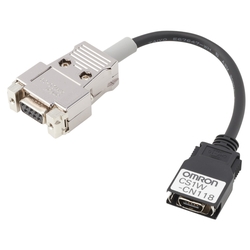
Description
## What is **CS1W‑CN523**?
* It is a **connection / extension cable** used in Omron’s CS (CS1) PLC family. ([hkcn.rs-online.com][1])
* Specifically, it’s a 5 m long I/O expansion cable that connects the CPU backplane or an existing expansion backplane to the next expansion backplane in the CS1 rack system. ([hkcn.rs-online.com][1])
* It is part of “Automation & Safety” product branding of Omron. ([allelcoelec.fr][2])
Key Spec Highlights (from datasheet / product info):
* Cable length: 5.00 m ([hkcn.rs-online.com][1])
* Connector type: Rectangular connectors suitable for CS1 backplane interfaces. ([allelcoelec.fr][2])
* Compliance: RoHS‑compliant ([allelcoelec.fr][2])
Thus, it’s not a “controller” or safety module itself, but a passive but critical cable in the CS1 modular PLC architecture.
—
## Pros / Strengths
1. **Standardized compatibility in CS1 ecosystem**
Because this is an official Omron cable designed for CS1 racks and expansion, it ensures mechanical and electrical compatibility (pinouts, shielding, connector fit).
2. **Reasonable cable length (5 m) for flexibility**
5 m gives you some flexibility in placing expansion racks — useful in larger panels or when spacing is needed.
3. **Passive and simple (low failure risk)**
As a passive cable (no active electronics), there is less to go wrong (no firmware, no power), so long as connector integrity and cable integrity are maintained.
4. **Shielding & Connector design**
Likely designed with proper shielding to reduce noise between the connected backplanes. (Typical in factory I/O cables)
5. **Ease in modular expansion**
It allows modular expansion of I/O racks in the CS1 system without redesigning wiring.
6. **Industry standard / known design**
Because it’s part of Omron’s established modular PLC lines, many engineers have experience with it, documentation is available etc.
—
## Cons / Weaknesses / Limitations
1. **Distance limitation**
5 m might not be enough in some large panels or spread-out installations. If you need further separation, you must ensure signal integrity or use repeaters or redesign rack layout.
2. **Passive cable — no signal conditioning**
Because it’s passive, if noise or signal degradation is significant (especially over distance, in noisy environments), you may see signal integrity issues.
3. **Connector reliability / maintenance**
Connectors (rectangular, multi‑pin) may wear, get bent contacts, or get loose over repeated insertions/removals. Good care is required.
4. **Obsolescence / availability concerns**
Depending on the age of your system, replacement parts may become harder to source, especially for specialized cable types in older systems.
5. **No safety function itself**
Although branded under “Automation & Safety”, this cable does not provide safety monitoring or safety isolation — its failure (faulty cable) could break I/O expansion and cause system problems.
6. **Fixed length**
If your layout needs a different length or routing (e.g. 7 m, curved paths), this fixed 5 m length may not be ideal; custom cables or routing may complicate things.
7. **Signal attenuation / noise in harsh environments**
In high EMI, long cable runs, or electrically noisy machinery, the passive cable may pick up interference, especially if shielding or grounding is not perfect.
—
## Common Q&A / Use Tips
| Question | Answer / Advice |
| ——————————————————– | ———————————————————————————————————————————————————————————————————————– |
| **What happens if this cable fails or is disconnected?** | The I/O modules on the downstream expansion rack will lose communication / power path, leading to faults, I/O errors, or system stoppage. |
| **Can I use a longer cable or multi-cable chaining?** | Omron’s datasheet defines 5 m for this cable. Going beyond may risk signal integrity unless explicitly supported. Use only approved extension cables or shorter runs. |
| **What precautions should I take in installation?** | Keep away from high-current power cables, route shielding properly, avoid sharp bends, ensure connectors are fully seated and secured, watch for mechanical strain. |
| **Can I use this in safety circuits?** | No — it’s only a connectivity cable. Safety circuits must use safety-certified modules, redundancy, fault detection, etc. |
| **What if my system is modernizing?** | If upgrading, you may want to migrate to newer PLC systems where backplane wiring is more robust, or even redundant/differential backplanes. But for existing CS1 systems, reliable cables like this one are essential. |
| **How to check if cable is good?** | Use continuity tests, check all pins, measure resistance, check shielding continuity, inspect connectors for bent pins, check for intermittent faults. |
—
If you like, I can compare the **CS1W‑CN523** cable vs possible alternatives (e.g. higher quality / shielded / custom) or suggest upgrade paths for CS1 systems. Want me to compare?
[1]: https://hkcn.rs-online.com/web/p/plc-accessories/2158179?utm_source=chatgpt.com “CS1W-CN523 | Omron Connecting Cable for Use with CS Series PLC-Based Process Control | RS”
[2]: https://www.allelcoelec.fr/productdetails/Omron-Automation/CS1W-CN523.html?utm_source=chatgpt.com “CS1W-CN523 |Omron Automation and Safety |Allelco électronique”
Reviews
There are no reviews yet.