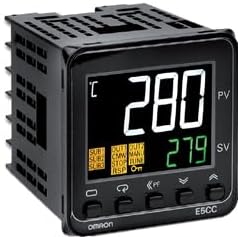
Description
Here’s a pros/cons + Q&A breakdown for the Omron E5CC-QX2ASM-800 Process Temperature Controller:
✅ Pros
- Universal Power Supply: Operates on 100–240 VAC, 50/60 Hz, making it compatible with global installations.
- Compact Size: 1/16 DIN format (48 × 48 mm) allows easy panel integration without taking much space.
- Advanced Control Algorithms: Provides accurate and stable temperature/process control with Omron’s proven PID technology.
- Wide Sensor Compatibility: Supports a range of thermocouples, RTDs, and linear inputs.
- Fast Sampling & Response: Enables precise control even in applications with rapid temperature changes.
- Clear Display: High-visibility LED display for process values (PV) and set values (SV).
- Flexible Outputs: Relay, voltage, or current outputs depending on configuration, suitable for SSR driving or direct load control.
- Omron Quality: Reliable, durable, and widely supported in industrial automation.
⚠️ Cons
- Learning Curve: Programming can be complex for beginners due to its multifunction settings and parameter depth.
- No Built-In Communication by Default: Some models require optional modules for Modbus/RS-485/Ethernet connectivity.
- Limited Display Features: Only basic numeric indication (no trend graphing like in high-end controllers).
- Fixed DIN Size: Only 1/16 DIN—may not be suitable where larger, multi-line displays are preferred.
- Potential Over-Spec for Simple Tasks: More advanced than needed for very basic ON/OFF temperature control.
❓ Q&A
Q1: What applications is the E5CC-QX2ASM-800 best suited for?
A1: Ideal for industrial ovens, furnaces, food processing equipment, plastic molding machines, and general process heating/cooling control.
Q2: How precise is its temperature control?
A2: It uses fast sampling and PID algorithms, giving highly accurate and stable control — especially valuable in processes requiring tight tolerances.
Q3: Does it support different input types?
A3: Yes, it supports thermocouples, RTDs, and linear input signals for broad application flexibility.
Q4: Can it be networked with PLCs or HMIs?
A4: Not natively — communication options (like RS-485/Modbus) require additional modules. For basic standalone use, wiring is straightforward.
Q5: Is this controller user-friendly?
A5: For basic setups, yes — simple setpoint and control can be configured easily. But for advanced tuning and multi-parameter setups, it requires familiarity with Omron’s programming style.
Do you want me to also make a comparison table between this E5CC controller and Omron’s smaller E5CN or higher-end E5EC controllers, so you can see which is better for different use cases?

Reviews
There are no reviews yet.