
Description
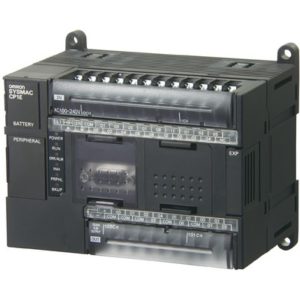
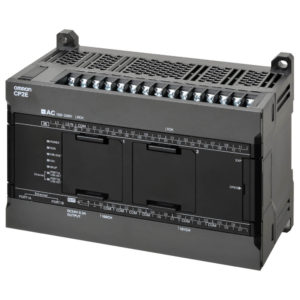
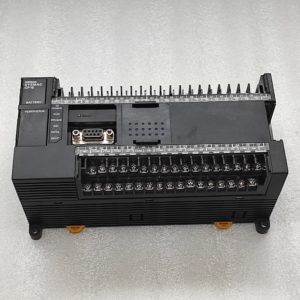
Here’s a Q&A style look at the Omron CP1E‑N60DT‑D PLC — what it does well, where it may fall short, and things to keep in mind.
Basic Specs / Overview
(From datasheets and supplier information)
- Supply voltage: 24 V DC (Cung Cấp Thiết Bị Tự Động Hóa)
- Built‑in I/O: 36 inputs, 24 outputs (total 60 I/O) (kwoco-plc.com)
- Output type: transistor (sinking) (Cung Cấp Thiết Bị Tự Động Hóa)
- Program memory: 8 K steps (≈ 32 KB) (ia.omron.com)
- Data memory: 8 K words (kwoco-plc.com)
- Processing (overhead) time: ~0.4 ms (ia.omron.com)
- High-speed counters & pulse outputs: supports up to 100 kHz in some modes (ia.omron.com)
- Expansion support: up to 3 expansion units, maximum total I/O up to ~180 points (with expansions) (ia.omron.com)
- Environmental & robustness: standard industrial ranges (0–55 °C, vibration, shock) (IndMALL Automation)
Pros (Strengths)
- Good I/O capacity “out of the box”
With 36 inputs + 24 outputs, you get a decent number of I/O without needing expansion immediately. Useful for mid‑sized control tasks. - Transistor (solid state) outputs
Being transistor (sinking) type, the outputs are faster, more durable (no mechanical contacts), and better suited for frequent switching than relay outputs. - Decent program & data memory
8 K steps for program and 8 K words for data gives reasonable headroom for fairly complex logic, data handling, and more features (for its class). - Supports high-speed counting and pulse outputs
It can handle fairly high-speed signals (100 kHz in some configurations) which is useful for motion control, encoder reading, or pulse generation tasks. (ia.omron.com) - Expandable & modular
You can add external I/O, communication modules, analog modules, etc., up to certain limits, which provides flexibility for future growth. - Reliable in industrial environments
It’s built with standard robustness (vibration, shock, temperature) expected in factory automation. (IndMALL Automation) - Cost-effective option
For many automation applications, CP1E models strike a balance between capabilities and cost, making them a good choice for moderate complexity systems.
Cons (Limitations & Trade‑offs)
- Limited memory for very large or complex systems
Although 8 K steps is relatively generous for its class, extremely large logic, advanced features, or many data manipulations may push you toward memory limits. - Expansion ceiling
You can only add up to 3 expansion units, and total I/O tops out (for 60 I/O base models) at about 180 points. For very large systems, that may not be enough. (ia.omron.com) - No built-in analog I/O
The base model is digital I/O only; if your system needs analog signals (e.g. 4–20 mA, voltage inputs, analog outputs), you’ll need to add analog modules which adds cost, complexity, and wiring. - Output drive limitations
Transistor outputs are solid-state but might have limitations in current or voltage drive depending on the load. For heavy loads (motors, large solenoids), you’ll need external drivers or relays. - Speed constraints for very tight cycles
Though it supports high-speed aspects, for extremely tight or fast control loops (sub-millisecond control, or very fast feedback loops), you might run into performance ceilings. - No built-in Ethernet / network port (by default)
Communications (Ethernet, etc.) are via optional boards/modules; not all models include them natively. (omron.co.id) - Obsolescence / future scaling risk
As your system evolves, you may outgrow this PLC and need to migrate to higher-end platforms for features, more I/O, or newer communication standards.
Q&A (Common Questions & Answers)
| Question | Answer |
| Can I use this PLC for analog data (temperature, pressure, etc.)? | Not directly in its base form. You must add analog I/O modules (input/output boards) via expansion. |
| What is the maximum total I/O I can reach with expansions? | Up to ~180 I/O (base + expansions) for 60‑point base models. (ia.omron.com) |
| Is the processing speed good enough for motion or encoder handling? | Yes, it supports high-speed counting / pulse outputs (up to ~100 kHz in some modes) which is sufficient for many motion/encoder tasks. |
| What communication interfaces does it offer? | It supports RS‑232C, RS‑485, USB (via optional modules) (kwoco-plc.com) |
| What happens when logic gets too big? | You may run out of program steps or memory. You might need to refactor, break logic into subroutines, or move to a higher-capability PLC. |
| Is it a good option for long-term, expanding systems? | It’s decent for moderate growth, but if you expect very large scaling or advanced networking/processing needs, eventually you might need to upgrade to a more advanced series. |
If you like, I can also compare CP1E‑N60DT‑D against some newer PLC models (e.g. Omron NX, CP2E, or others) for your specific application to see whether it remains a good choice. Do you want me to do that?
Reviews
There are no reviews yet.